13/06/2020 – My grandmother’s house

I had this really strange experience today. I went to my grandmother’s house, one of the most familiar places ever for me, and yet, because of my time in the US and the stay-at-homer order, I felt completely defamiliarized with it. To be more precise, it felt like I was rediscovering my familiarity with the place where I spent so many summer weeks with my cousins. This feeling was so strong and so strange that I did my best to register it, to breathe it in and to record every little feeling and sensation it brought me.

They say that olfactory memory is the strongest – or at least one of the strongest – sense of memory that we have. And indeed, as I rediscovered each room, each with its peculiar smell, so many memories came flooding back, memories half-forgotten that I hadn’t thought about for more than a decade sometimes. I felt like I was an amnesiac who was suddenly recovering everything at once, like almost every single memory associated with my grandmother’s house came rushing back at the same time, painting me the broadest image possible of the time I spent there.

It’s really strange how that house fits in my memory. On the one hand, I associate it with some of the best moments of my life, wonderful days and evenings of Summer fun and mischief with my two favorite cousins. But it is also a recurrent setting for my nightmares, for some reason. For instance, when I have nightmares about bats (they freaked me out way before covid), they’re often set in a dark corner of that house.

The most magical room in my grandmother’s house is the attic. It’s a place where my dad and his brothers and sisters would play around as children, and us grandchildren picked up the torch and somehow made it this place that was ours within our grandparents’ home. It was and still is, by far, my favorite place in the house. But it also retains an unsettling character in my mind, for some unexplainable reason.

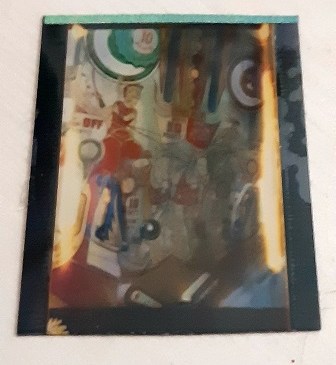
The most fascinating aspect of this place is its furniture, consisting mostly of old, discardable furniture actually. Old TV sets from the 70s and 80s can be found there, as well as old Christmas ornaments, old toys, old chairs, old books, old camping equipment, old suitcases, … There’s also an old bed in which my cousin pledged to sleep a whole night once, but of course he never did because there are way too many spiders and god knows what kinds of other creatures there. There’s a sort of wobbly couch that is actually the whole backseat of an old car of theirs. My brother turned it into what he called a “roller-coaster ride”. There’s a bunch of stuff my cousins and I brought in order to turn it even more into a playroom for us. The walls are covered with the graffities and drawings we made in chalk throughout the years. There are also some planks, old chairs and ski poles that we put together in order to create a “spaceship”, using and old Puy du Fou map for our travels. And there’s that TV that my dad tried – and failed, or at least gave up trying – to turn into a robot.

And, most of all, there are a pinball machine and a foosball table bought by my dad from a café somewhere in France when he was a young adult. The coolest pieces of furniture, the source of our pride. Strangely enough, as much as I have always loved the pinball machine – and I really do – it kind of terrified me as well as a child. There was a mechanism that prevented people from shaking it too much. If you did, often because your ball had gotten stuck somewhere, this “tilt” mechanism was triggered and not only did the machine become completely unresponsive – meaning you inevitably lost – but it also started making this loud, awful, shrill noise that you could only stop by flipping the switch of the machine. And sometimes even that didn’t work. You had to try a few times or wait a few days instead. I used to have nightmares about this noise, and it also made the room a bit dauting, this place that I loved but where not everything was under my control. (Once, I also dreamed that Lady Gaga went hiding from the police into my grandma’s attic so it’s not all bad though.)

It’s hard to articulate how ambivalent my feelings are about this place in general, but today the unheimlich reached a whole new level. Usually the only dust to be found there is in the attic (my grandma has a maid).But today it felt like there was dust everywhere, and especially on my memories, and I was the archeologist going through it, making sense of it, like I was slowly easing back into my old, French life after those months abroad. Is it what it feels like to grow up? Is my childhood becoming increasingly harder to reach? It’s both scary and fascinating…
05/03/2020 – L’inquiétante étrangeté des VHS

C’est toujours étrange quand on a pensé quelque chose depuis longtemps et que tout d’un coup, sans prévenir, on entend des gens en parler. C’est d’autant plus étrange quand il s’agit d’une impression qu’on a depuis l’enfance. Ça m’est arrivé aujourd’hui en écoutant l’émission « Par Jupiter » de France Inter dans laquelle était invitée la musicienne Jennifer Ayache du groupe Superbus.

Les chroniqueurs et l’invitée discutaient de l’attrait qu’on peut avoir pour le rétro, notamment en matière de technologie. Ils ont ensuite parlé du dernier clip de Superbus qui a été tourné avec une caméra VHS par nostalgie. Mélanie Bauer a alors commenté : « y a un côté anxiogène […] dans la VHS », puis plus tard « même un truc joyeux, ça devient dérangeant ». Charline Vanhoenacker, elle, a ajouté : « y a une tension ».

J’ai toujours eu une relation ambivalente à la VHS. D’un côté, c’est les souvenirs des films regardés à la maison le weekend, chez mes grands-parents pendant les vacances, ou sur le temps de midi à l’école les jours de pluie. Puisqu’aucune de ces collections vidéo n’était astronomique, c’était souvent les mêmes films que je regardais encore et encore. Je me souviens même qu’avec mes cousins on trouvait hilarant de rembobiner la cassette à faible vitesse, car cela nous permettait de regarder le film à l’envers, et donc toutes les actions devenaient étranges et les gags plus drôles encore. On utilisait encore aussi la VHS pour enregistrer les émissions télés qu’on ne voulait pas manquer, ou bien celles qu’on souhaitait conserver. Je ne compte pas les fois où mon père m’a enregistré la Star Academy. J’ai également toujours adoré revisionner les films de familles enregistrés sur des VHS, bien que certains se soient fortement dégradés avec le temps.

Et pourtant, j’ai toujours eu un rapport tendu avec les cassettes vidéo. Déjà, il y a toujours eu cette crainte d’abimer la cassette, ou bien que ce soit le magnétoscope (c’est incroyable comme ce mot me semble daté !) qui la « mange » carrément. Combien de VHS a-t-on retrouvées inutilisables à leur sortie de l’appareil ? Mais, par-dessus tout, c’est la fin des cassettes que j’attendais toujours avec énormément d’appréhension. Dès que je sentais la fin du programme approcher, je me jetais sur la télécommande pour interrompre la lecture. Tout ça pour éviter ce que certains appellent le screen of death (bien que je ne sois pas sûre que ce terme s’applique bien ici, puisqu’il fait normalement référence aux écrans d’erreur des systèmes d’exploitation. Mais j’aime beaucoup la connotation lugubre de cette expression !).

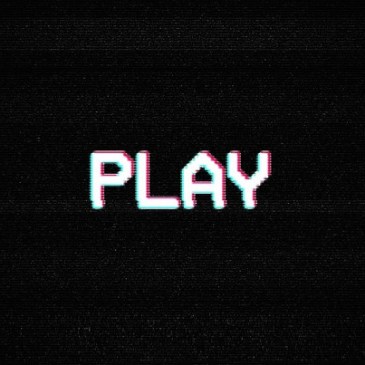
J’ignore si c’est quelque chose de particulier au magnétoscope de mon enfance, ou bien à certaines cassettes en particulier, mais je me rappelle que, les rares fois où je n’ai pas été assez rapide, l’écran qui est apparu à la fin du programme était tout bonnement terrifiant. Des vagues grisâtres traversaient une étendue noire dans une bruit terrible. Une vision insoutenable pour l’enfant que j’étais, si bien que je m’arrangeais toujours pour arrêter la cassette juste avant. J’ai tendance à penser que ce genre d’angoisses irrationnelles rencontrées pendant l’enfance gardent une influence durable sur l’adulte qu’on devient.

Je ne sais pas exactement pourquoi cette représentation du passé et de sa technologie obsolète me met si mal à l’aise, au même titre que les locomotives et les horloges, entre autres. Dans ce cas précis, l’enfance représente en général une période idéalisée de bonheur et d’insouciance qu’on regrette à l’âge adulte, et je ne fais pas exception. Et pourtant, les images VHS restent profondément anxiogènes et dérangeantes pour moi. Lorsque mon œil perçoit, sans s’y attendre, leurs images d’une qualité médiocre, traversées de vagues, à la couleur et au son qui ont tendance à « dérailler », qui « sautent », c’est mon corps tout entier qui est parcouru d’un frisson d’effroi. Et il semble que je ne sois pas la seule à le ressentir.

16/07/2019 – Les châteaux

J’ai longtemps été passionnée par les châteaux étant petite. (Par ailleurs, j’ai toujours du mal à écrire « bateau » et « château » ; je dois toujours me demander lequel prend l’accent. Seul le passage par l’anglais m’aide.) Je me jetais sur n’importe quel livre parlant des châteaux forts et dévorais les descriptions de la vie quotidienne au Moyen-Âge. (Encore un mot auquel je ne sais jamais si je dois mettre des majuscules ou non, un tiret ou non, un accent ou non. Est-ce correct de mettre des accents sur une majuscule ?)

Cette passion s’est quelque peu estompée avec les années. Mais j’aime toujours visiter des châteaux de temps en temps. J’ai réfléchi aujourd’hui au sens que ce mot pouvait avoir pour moi. Et il se trouve que les châteaux ont eu leur importance dans ma vie. Seulement pas ceux qui pourraient paraître les plus évidents.

Le premier château de mon enfance, au-delà des châteaux moyenâgeux, est celui de Dammarie-les-lys, communément appelé le Château des Vives-Eaux. Ou plutôt non. Son nom le plus commun serait Château de la Star Academy. En effet, la société de production Endemol a été locataire de ce château situé à une trentaine de kilomètres de chez moi. Et le château était véritablement le symbole de l’émission. Moi qui rêvais devant ma télévision de faire partie de cette grande « aventure », comme ils ont le goût de décrire leurs programmes, ce château représentait pour moi le lieu le plus magique qui puisse être, celui où les espoirs de succès et de célébrité pouvaient se réaliser. Bien sûr, avec le recul, je me rends compte que la notoriété et le succès apportés par une participation à la « Star Ac’ » était toute relative.

Un deuxième château qui a une charge symbolique importante pour moi est celui de la ville d’à côté de chez moi – celle où j’ai été au collège et au lycée – le château de BCR. Je ne me rappelle plus la première fois où j’y suis allée, mais je me souviens avoir assisté à la fête médiévale de la ville au moins deux fois avant d’entrer au collège. Mais c’est véritablement au collège que le château est devenu un lieu à la fois familier et exotique. C’était l’endroit où nous finissions toujours lorsque nous allions nous balader « dans brie » lorsque nous avions une heure de perm ou bien lorsque la cantine faisait grève. Cet endroit souvent désert en semaine, bien à l’écart du collège, était synonyme de liberté, synonyme du temps de l’insouciance passé à faire des bêtises sans gravité et dépenser nos économies en bonbons et grecs. Ce lieu a largement perdu de son importance lorsque je suis entrée au lycée et que nous pouvions désormais sortir au McDo et au Hyper U. C’est seulement depuis ce moment-là que j’ai enfin commencé à le considérer comme ce qu’il est réellement : un château médiéval en ruines.

Le troisième château est celui de Disneyland Paris. C’est un château qui n’en est pas vraiment un, fait de carton-pâte, comme diraient certains qui affectionnent Baudrillard. Mais si la magie qui l’habite est toute relative – et commerciale – ça n’empêche pas qu’il revêtît, pour moi, une symbolique émotionnelle toute particulière.

C’est le symbole du Parc Disneyland (par opposition aux Walt Disney Studios qui ont pour symbole la Tour Earfell) et il reste de très loin le monument du parc le plus photographié. On y voit tous les influenceurs posant de manière absurde, entre autres… C’est aussi le symbole de Fantasyland, mon lieu de travail (ma « location »). Je n’ai jamais travaillé dans le château lui-même mais je pouvais l’apercevoir depuis mes postes de travail et j’y passais au moins deux fois par jour sur la route pour aller manger. J’ai aussi passé des heures sur son pont lorsque j’étais en « position pont parade », c’est-à-dire lorsque j’étais en charge de la surveillance des visiteurs situés sur le pont du château lors de la parade quotidienne. Une tâche appréciable car elle permettait de faire une pause loin de l’attraction et de son rythme soutenu, mais aussi désagréable car il s’agissait de faire la police et d’aller « casser les pieds » aux gens qui ne respectaient pas telle ou telle règle de conduite. Il était rare de s’en sortir sans soupir ou reproche.

Pour moi ce château si original (c’était le premier château Disneyland auquel on a volontairement donné un aspect plus féérique car l’Europe, peuplée de châteaux médiévaux, avait besoin d’un peu plus que les Etats-Unis. Les Imagineers se sont notamment inspirés du mont Saint-Michel) représente vraiment l’identité de Disneyland Paris en tant que destination particulière, différente des autres parcs Disney. Quand je le regarde, je suis replongée dans l’ambiance si singulière de ces journées de travail.

03/05/2019 – The Locomotive

I am fascinated by the mental picture of a locomotive upside-down. It’s an image I associate with dreams, and thus Surrealism. I think it first came to me from a J’aime Lire story I read many times as a kid. I cannot remember its title but it was about a young orphan and his grandfather, who had managed to build a time-machine, going back in time in order to retrieve a long-destroyed – and thus expensive – painting by some famous painter (I think Chagall?). They are being threatened by thugs who simply want to make money out of it. The boy and his grandfather end up tricking the thugs, I don’t really remember how, and the art remains safe, away from their financial interest. I cannot remember if the painting is shown at all in the book (though my sense of logic tells me yes!) or if I just created its image in my head, but it has been fascinating me ever since.

Years later, I looked for this painting but didn’t find it. I’m pretty sure it was made-up. But I still hold onto this image. I sort of found it when I studied Man Ray and Paul Eluard’s Les mains libres in high school. There’s a drawing entitled “Rêve” that depicts a kind of flying, upside-down locomotive above city buildings, along with the notion, in Eluard’s poem, of a bent Eiffel tower and of twisted bridges. I love both the drawing and the poem because they depict the notion of the familiar being distorted just enough to represent the power of imagination, something that I enjoy both in dreams and in Surrealism, among other things.

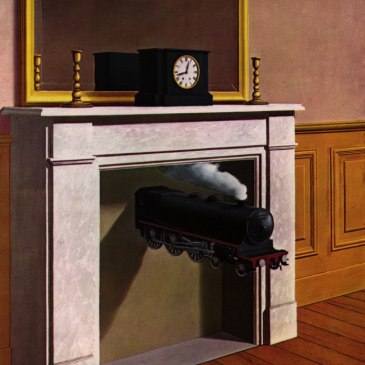
Also in high school, but two years earlier in fact, I came across Magritte’s La durée poignardée and had some sort of revelation. This painting depicts a locomotive coming out of an otherwise empty fireplace. On top of it, there are two candlesticks on each side of a clock, and above them is a mirror. It’s interesting to note that the candlestick on the right has no reflection. To me, the locomotive, emerging at full-speed and on a straight line, seems to stab the fireplace which becomes a tunnel, that is where the title comes from. The locomotive represents modernity, embodied by a machine that overpowers mankind and imposes its rhythm on them. The clock, which represents time, seems to be receding because of the mirror, unlike the locomotive which is going forward. Magritte said this about the painting:

« L’image d’une locomotive est immédiatement familière, son mystère n’est pas perçu. Pour que son mystère soit évoqué, une autre image immédiatement familière – sans mystère – l’image d’une salle à manger a été réunie avec l’image de la locomotive. »

As I was supposed to relate the painting to Surrealism, I wrote that the scene seems “normal” until the insolite element – insolite not because of its content, which is familiar, but because of its unexpected presence which makes it out-of-place – bursts in to break the realism, or rather the illusion of it. The painting associates two pictures which, at first glance, do not belong together, using the fireplace/tunnel as a point of connection, in order to create a feeling of shock in the viewer.

My persistent fascination with this painting led me to write, two years later, the following poem:

Le Progrès Poignardé

Loco, fou est cet engin au rythme effréné

Sifflant l’universelle mélodie du tocsin

Bête fougueuse et anarchiste

Elle disparaît dans l’antre obscure sans laisser d’autre trace

Que des oreilles bourdonnantes et des pensées embrumées

Terrifiante et assassine, sans cesse,

Elle avale l’or ténébreux dans son gosier vorace

Crissant « Charbon ! Charbon ! Charbon ! » comme leitmotiv

There are many ways in which the image of the locomotive keeps coming back to me: most obviously with the Hogwarts Express, but that one does not produce the same effect on me at all. More interestingly, there is Zola’s La bête humaine, also read during my first year of high school, a book that I absolutely loved, especially the scene in which there’s an accident and the locomotive is described as a torn human body. Obviously, my reaction to the Magritte painting was very much influenced by Zola’s novel.

One last example is that of the famous picture of the Montparnasse accident of 1895 which depicts a locomotive hanging from the wall of the first floor of the station that is half demolished. Last year, I wrote in a paper that “The pitch-black locomotive crosses the rectangle of the picture diagonally in a motion that feels very transgressive and is impossible to escape when looking at it. I believe that the black-and-white is very important because it displaces the image both into the past and into the unreality of history. The situation is so irrational that the picture seems to come from a nightmare. To me, it coincides with the idea of the past as a dangerous place of chaos, tragedies and unreason that we may have […] of the middle-ages or of the pre-democracy, pre-consumer society times. It makes us feel both safer about our lifetime – we do not use locomotives anymore, this technology was probably more experimental, this could not happen again – but also more uncertain – if it has happened, it can happen again; technology can be dangerous.”

This is what the image of the locomotive ultimately is to me: a symbol of a dark (and somehow also black-and-white), scary (for some reason), remote past. It is also something I sense in the image of the Normandy clock. My grandparents own one, and I was absolutely terrified of it as a child. Nowadays, still, I have very mixed feelings about it. Thinking about it makes me uneasy, and yet I am so attached to it that I would love to be able to own it after the death of my grand-parents (that probably has to do with the fact that my grand-father is himself quite attached to it). Hearing it ring in the middle of the night is both chilling when I think about it, and also a source of comfort when I actually hear it because it means that I am in a place where I feel happy and safe.

Ultimately, apart from this actual object, both Normandy clocks and locomotives make me think about time, scary time.