Cancel culture in 2003
I’ll try to keep this one will be short(ish) but it will be full of interrogations, as I too am.
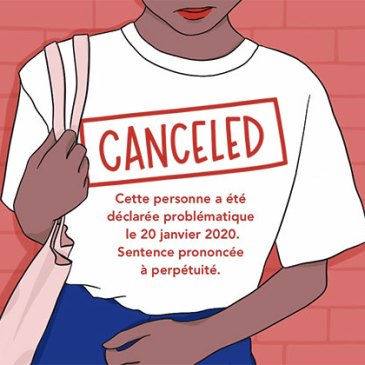
In the past few years, we’ve been talking a lot about cancel culture, especially with the emergence of social media – and what I really mean here is Twitter. Though the phenomenon draws from historical precedents, it can be safely said that the practice has really entered the mainstream from the moment Twitter became synonymous (no matter how erroneously) with “the people”.
Without making a habit of it, I’m going to look at a dictionary definition (Merriam-Webster’s) of this catch-all term: cancel culture is “the practice or tendency of engaging in mass canceling as a way of expressing disapproval and exerting social pressure” as well as “the people who engage in or support this practice”. Described this way, it’s hard to see the difference between this and censorship though there seems to be one key difference: it is supposed to come from the people and not the government.
The questions of who this “people” – or perhaps rather these people – may be is a whole other issue. Nowadays, the expression is found mostly in the declarations of conservative, right-wing supporters who use it to complain about the criticism and the attacks that they receive from (often younger) progressive left-wing supporters (also known as “woke”, as our dear Blanquer knows very well…). The idea is that these progressive people would track the words and actions of pretty much any one, ranging from anonymous citizens to famous figures, and even more so, it appears, those who have voiced progressive views in the past (J.K. Rowling, for example, used to be a fervent Trump and Brexit criticizer, until she revealed her transphobic views to the world). Then they would try and find those they could deem problematic (that is to say, racist, misogynistic, LGBTQ-phobic, etc) and then decide that these people become canceled: audiences must not engage with them, they should be banned from cultural acknowledgment, excluded from the public sphere, etc. Some of these social justice warriors, as detractors like to call them, even encourage bullying and real-life violence. Of course, most of you already know that.
Without going into details over a specific case, the practice has undoubtedly proven efficient in the past few years and it has led to significant improvements such as with Harvey Weinstein. However, and I am aware that I am stating the obvious here, it has many, many problematic aspects. To keep it short, in many ways, it is a 21st-century form of puritanism in which the notion of “innocent until proven guilty” is no more; there is no possibility for an individual to say things and then change their minds, or be uninformed at first, or learn new things, or improve, or be clumsy; each and every one of us must pick a side – “you’re either with us or against us” as they used to say around 2003; there is no notion of a nuanced opinion – and everything leads to Nazis and Hitlers, as Godwin predicted; opinions themselves have been conflated with people and their identity – you are what you say, whether you meant it as such or not; and, finally, many people do not seem to care about carrying a discussion anymore, or even convincing others with arguments so that they would change their minds rationally and not just to avoid people’s rage. Basically, cancel culture sucks, very much so. Wherever it’s coming from and towards whomever it is directed. But it’s easy to forget that sometimes, especially when you find yourself particularly detesting the views of certain people (looking at you JKR, your betrayal still cuts deeply) or even feeling threatened by them (talks of civil wars in numerous Western countries…)
That’s why, I always try to remind myself of the one case that hits very close to home
As you may know, the (then Dixie) Chicks faced an embryonic form of cancel culture after their singer Natalie Maines dared to face an anti-war opinion at a concert on foreign soil (London, the only part of her statement that the Guardian reported on at the time was “we’re ashamed the president of the United States is from Texas”, hardly a strong political statement…) I am not going to recap the whole thing and the trauma it left them in, their documentary Shut Up and Sing does that very well. But what we need to remember is that they were insulted on national television (“These are callow, foolish women who deserve to be slapped around”, “the dumbest, dumbest bimbos I have ever seen” “the Dixie Twitz” “Dixie Sluts”, etc cf their Entertainment Weekly cover), people organized online to stop radios from playing their music (an organization called the Free Republic) and to gather people to destroy their records publicly or to attend their concerts just to boo them, they received death threats and the Senate Commerce Committee even examined the whole situation. All of this culminated into one very real death threat that had the FBI investigating the attendees of a Dallas concert in 2003. To this day, almost twenty years later, most country platforms still pretend they don’t exist and many of their listeners see them as traitors, even though they were proven right in their rejection of the Iraq war. Of course, the “incident” – as they have come to refer to it – has also had a profitable effect on their career as it allowed them to embrace progressive views more freely and to establish themselves as defenders of free speech. Probably the main reason that their Taking the Long Way (my favorite album of theirs) won no less that five Grammy Awards in 2007.
The takeaway from all this for me, is how can I defend a system that almost destroyed my favorite band? Why is it that I can get behind cancel culture when it suits me but not when it doesn’t? Shouldn’t I treat my neighbor as I treat myself? Shouldn’t I treat those people who disagree completely with me just as well as those who don’t? How can I decide what is the moral code on which we should all agree? Is there even one? (There must be, I can’t get behind any form of discrimination or violence) Can’t we disagree without it being an aggression? So many questions, so few answers. Or simple ones, at least. I must admit that I don’t know.
The Chicks released a song alongside their documentary. It was recorded for Taking the Long Way but they kept it for the film in the end. It’s called “The Neighbor” and it says “Come out in your backyard Monday / Let’s meet on your front porch Friday”.
 Journal de Pensées